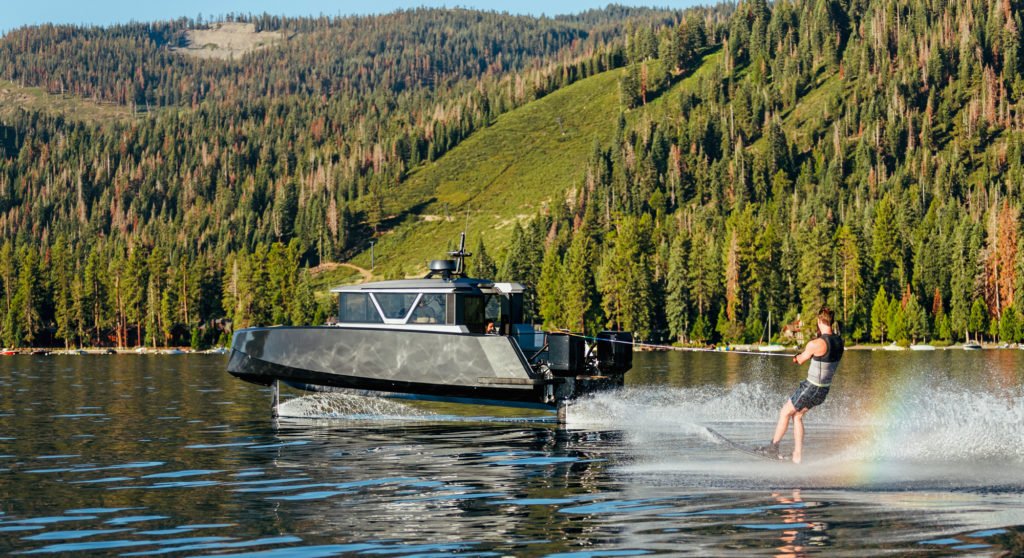
It’s a bird, it’s a plane, it’s a Navier N30! Rich Ross, the proud American owner of hull number one of the Navier N30, calls his vessel the “Magic Carpet.” It’s a fitting moniker for a machine that seems to soar above the waves. “Navier could not have a more enthusiastic ambassador than me,” Ross beams, having volunteered to give demo rides just to spread the word. This all-electric hydrofoiling boat is positioned as much a cleaner, more efficient dayboat as she is a tender for future-minded superyacht owners.
In the fall of 2025, I joined Ross in Fort Lauderdale aboard his boat to see for myself. We departed with the foils raised, gliding along quietly until, with a button press, the three foils—two aft, one forward—deployed. Instantly, we were airborne, skimming over the water at 30 knots. Ross kept an eye out for neighboring boats’ wakes, eager to show how the Navier N30 traversed over them with barely a tremor. A draft-adjustment feature allows shifting from 6’3” (1.9 meters) for foiling down to 18 or 24 inches, adapting to conditions accordingly.

Ross is a lifelong boater who’s owned everything from small craft to a 2,000-square-foot (186-square-meter) motoryacht. “My N30 would have made a fantastic tender to that yacht!” he says. These days he happily cruises his dayboat around Hilton Head and the Lowcountry. His fascination with hydrofoils dates back to a 1985 ride on a high-speed ferry from Hong Kong to Macau. Ross remembers how smooth the ride was over rough seas. “After more than a year of online research into electric boats with cabins, I discovered Navier’s plan for an all-electric hydrofoil with a cabin, and I was hooked,” he relates.
Ross’ passion for innovation and sustainability aligns perfectly with that of Navier’s CEO and co-founder, Sampriti Bhattacharyya. Bhattacharyya grew up in India and at age 20 arrived in Chicago with just $200 and big ambitions. Besides holding a PhD in mechanical engineering from MIT, she took astrophysics and cosmology classes as a hobby. Additionally, she launched a company making underwater drones for ocean mapping and interned at NASA, all while pursuing her degree. Bhattacharyya’s true fascination, however, is Earth’s oceans. “I’m more interested in exploring our planet’s oceans rather than getting to Mars,” she says.

Although hydrofoil concepts date back to the 19th century, Navier’s breakthrough is a proprietary operating system. Sensors feed live data about wave conditions to onboard software, which continually adjusts the foils for a smooth and stable ride. Twin 90-kW electric motors propel the Navier N30 to more than 30 knots. The boat further offers a range of 75 miles at 20 knots. Thanks to the foils, drag reduces by more than 80 percent. This makes the zero-emission electric craft 10 times more efficient than conventional gasoline-powered boats.
To realize this vision, Bhattacharyya partnered with two equally forward-thinking professionals. One is the renowned naval architect Paul Bieker, a veteran of three America’s Cup campaigns utilizing foiling technology. The other is Kenny Jensen, whose background in control systems, autonomy, and electric vehicles suits him as Navier’s CTO, pushing its technical envelope. Together, they’ve built Navier’s electric foiling boats as platforms for revolutionizing waterborne transport. It goes beyond recreational yachting. In fact, they envision a future where high-speed, efficient electric craft move people and goods. “We want to offer clean commutes in cities with water access—beating bumper-to-bumper traffic on the highways,” Bhattacharyya explains. Note, too, that Navier’s headquarters are in Alameda, California, infusing some new energy into the waning American boatbuilding industry.

The newest Navier model, the N30 Pioneer II, elevates the experience further. “Pioneer II is the most advanced electric recreational vessel on the market,” Bhattacharyya asserts. “It’s a sanctuary on the water—clean, quiet, conscious luxury that still delivers an adrenaline rush.” Leveraging the Navier N30 architecture, it eliminates more than 80 percent of drag and draws on thousands of real-world foiling hours. The core operating system offers military-grade reliability and redundancy as well. Furthermore, the vessel offers a dashboard displaying real-time charging status, preventing range anxiety. As for the layout, you’ll find a convertible sunbed lounge, an optional overnight bed configuration, a fishing configuration, and more. Starting at $850,000, the Pioneer II is a limited-edition, invitation-only model.
More than a year after taking delivery of his Navier N30, Ross is still thrilled. “There’s only one other fully electric hydrofoil boat out there,” he notes. “But it has no cabin, is less stable—especially due to its single forward hydrofoil—and has a shorter range and lower speed.” As someone who’s owned eight Tesla cars, he’s devoted to all-electric operations, especially the lower maintenance. “All I ever replaced was a seatbelt sensor and a lightbulb,” he says of his cars. “Some call the N30 the Tesla on the water,” he reflects. “In my first 60 days, I took 52 trips—the technology blows me away.”
Navier navierboat.com