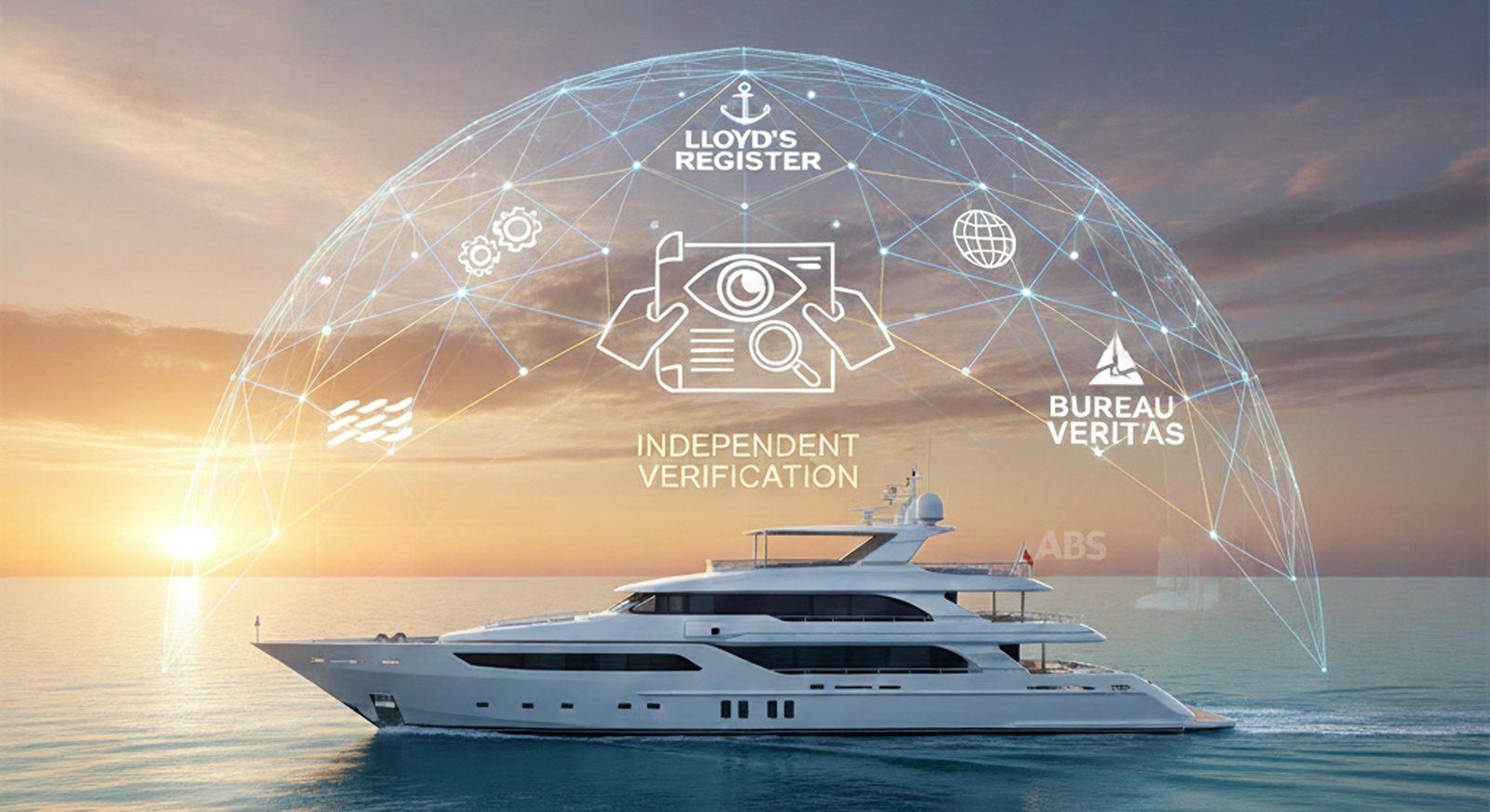
You’ll likely familiar with the names American Bureau of Shipping (ABS), Bureau Veritas, Lloyd’s Register, and RINA. They’re the leading classification societies in yachting. As rare as it is, sometimes individuals building or buying a megayacht view classification as a nice-to-have benefit versus an essential step. However, recent industry developments and high-profile maritime incidents bring stronger attention to the matter. Furthermore, knowing of these organizations is quite different from actually understanding yacht classification. So, what exactly does classification provide, and why should you care?
Classification societies are independent, sometimes centuries-old organizations entirely focusing on maritime safety standards. They’re not governmental regulatory bodies. Instead, they’re specialized technical authorities that establish and verify compliance with rigorous engineering and construction standards.
Classification standards can surprise even experienced owners. In fact, they can and do extend beyond hull integrity and propulsion systems. They establish requirements for equally critical systems and components that contribute to safe operations. These range from fuel-line routing to seemingly unimportant details like handrail placement. Overall, every element reflects decades of knowing what can prevent accidents at sea.
There are even more examples. Take, for instance, stairway dimensions. Class societies specify both the depth and the width of the steps. They do so based on human factors (a.k.a. ergonomics) as well as the dynamics of a superyacht’s motion. Consider how guests may be unfamiliar with your yacht’s movement while cruising or even at anchor. Similarly, the organizations specify that fog horns need to be audible for certain statute miles. Plus, navigation lighting standards take the earth’s curvature and sightline limitations into account.
Class societies don’t just write rules, though. They have inspection regimens. Annual surveys, comprehensive five-year surveys, and detailed 10-year special surveys all examine systems, including valves, and structural elements. Verifying proper maintenance helps preserve not only safety, but also your yacht’s value over time.

The Cost-Benefit Equation
Speaking of value, typically objection to classification comes down to cost. Some owners believe it will interfere with design. In the past, some shipyards asserted that their own standards exceeded class requirements, and that there was no need for third-party validation. However, experienced owners’ representatives, captains, and owners themselves recognize independent verification for what it is.
When you’re making the financial calculation, remember that it extends beyond initial build or milestone-oriented survey costs. Classed yachts typically command higher resale values and further may benefit from more favorable insurance terms. Additionally, classification can prevent catastrophically expensive mistakes. Seemingly aesthetic-only details or particular system installation might seem like no big deal until real-world conditions test—and stress—them. At that point, the cost to correct them can add up to multiple figures, and at worst they can rival the yacht’s initial value.
Interestingly, the distinction between commercial shipping and yachting when it comes to classification is telling. In the commercial sector, vessels lacking class status are considered suspect. Some of the flag states in the commercial sector are suspect, too, allowing non-classed ships. By contrast, in yachting, both underwriters and owners drive the push for classification. Related, if a previously classed yacht falls out of class, neither the underwriter nor the flag state will allow the yacht to remain under its umbrella.
Making the Classification Decision
Owners with projects in the entry-level superyacht range face genuine choices. Some builders of semi-custom yachts certify to European CE standards or American ABYC standards versus full classification. There’s certainly nothing wrong with CE or ABYC standards, as they both offer baseline safety validation. Since classification societies offer a more comprehensive, lifecycle-focused approach, weigh your decision pragmatically. Classification adds cost and complexity, requires ongoing survey compliance, and may necessitate design changes. Still, it provides independent assurance that the yacht meets proven safety standards, facilitates insurance coverage, and offers systematic oversight of maintenance and modification work throughout her operational life.
Ultimately, in understanding yacht classification, the question isn’t whether the standards are perfect. No system is perfect, of course. Instead, weigh the demonstrated value of independent technical oversight against relying solely on builder reputation and in-house quality control. The case for classification grows stronger as both vessel size and operational ambitions increase. Classification represents neither regulatory requirement nor unnecessary burden, but rather a proven framework for managing technical risk in an inherently challenging operating environment. As the yachting industry continues maturing, the question may shift from “Why class?” to “Why not?”
American Bureau of Shipping eagle.org
Bureau Veritas group.bureauveritas.com
Lloyd’s Register lr.org
RINA rina.org