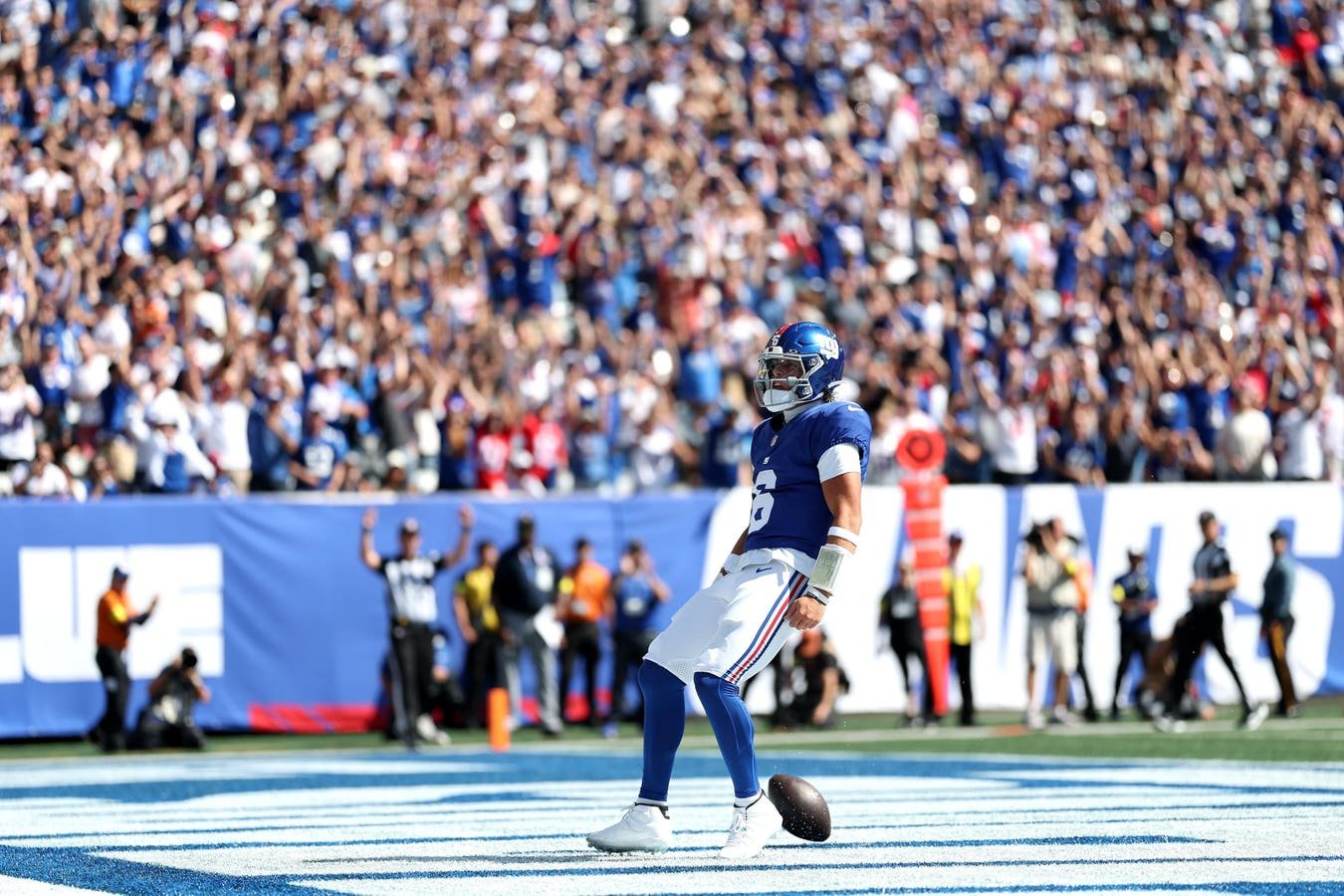
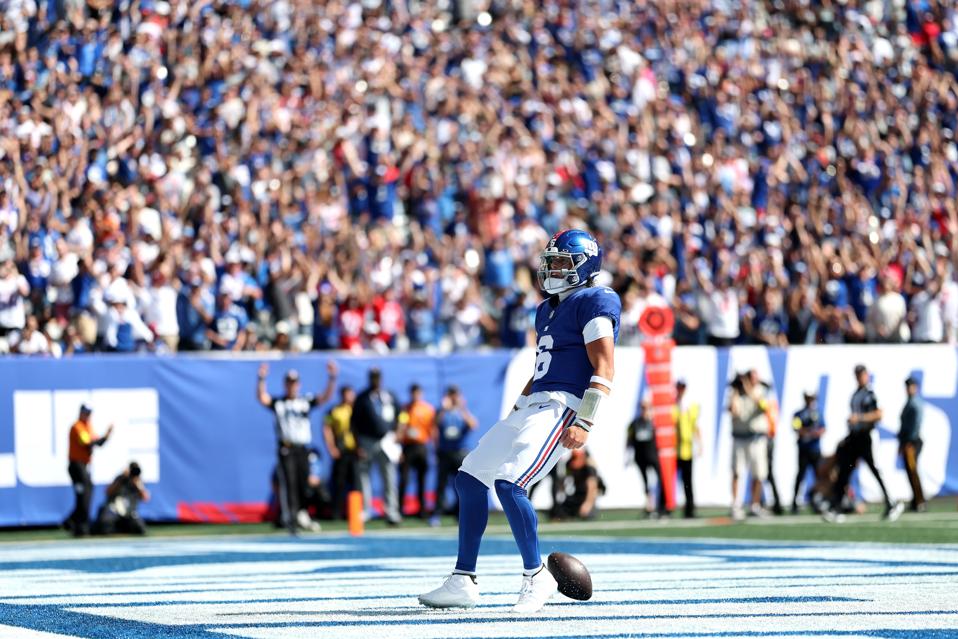
EAST RUTHERFORD, NEW JERSEY – SEPTEMBER 28: Jaxson Dart #6 of the New York Giants celebrates a rushing touchdown against the Los Angeles Chargers during the first quarter in the game at MetLife Stadium on September 28, 2025 in East Rutherford, New Jersey. (Photo by Ishika Samant/Getty Images)
Getty Images
In Week 4 of the NFL regular season, New York Giants first-round pick Jaxson Dart became the second rookie quarterback to start a game this season.
And with the lofty expectations that playing in New York presents, Dart delivered.
Dart finished with 111 yards and a touchdown in the air, and 54 yards and a touchdown on the ground. While these numbers may not stand out on the stat sheet, they were enough for New York to win their first game of the season, taking down the 3-0 Los Angeles Chargers.
There was speculation about whether this was the proper starting point for the quarterbacks’ young careers. Should he have been given the role to start the season? Should he have spent the entire year developing his skillset before being exposed to the world?
Even more than these questions was the speculation on whether this was the plan around Dart all along. And if so, why did they pick this Week 4 matchup against an undefeated team?
The short answer is no, this was not always the plan for the former Ole Miss star.
If we look back to the preseason for New York, the free agent signings of Russell Wilson and Jameis Winston were to fill a need at quarterback for the upcoming season.
Then, when the Giants traded up in the NFL Draft to select Dart, the picture became even clearer.
LANDOVER, MARYLAND – SEPTEMBER 07: Russell Wilson #3 of the New York Giants looks on after turning the ball over on downs against the Washington Commanders during the fourth quarter at Northwest Stadium on September 07, 2025 in Landover, Maryland. (Photo by Scott Taetsch/Getty Images)
Getty Images
Wilson, on a one-year, $10.5 million contract, would be a game manager for a developing roster looking to play meaningful games at the end of the season.
Dart would learn under the wings of the veteran, Super Bowl Champion, and take over the reins for next season and those to follow.
Winston, working under both Wilson and Dart, would be the veteran backup who knows Head Coach Brian Daboll’s system for this and next season, which explains why Winston was signed before Wilson on a two-year, $4 million contract.
We will never know if Wilson was signed to start every game of the 2025 season, or if there were always intentions this year of Wilson passing the torch to the 22-year-old
However, in a year where the job security of Daboll, General Manager Joe Schoen, and the rest of the coaching staff are in jeopardy, a 0-3 start and 27th-ranked offense seemed to adjust the timeline.
Following the Giants’ Week 3 loss to the Kansas City Chiefs, where New York was limited to just 9 points and 160 passing yards, the move was announced almost immediately to Dart.
That means that Dart had three weeks within the regular season to go through the traditional schedule of the NFL. This includes listening in on the in-game conversations of Offensive Coordinator Mike Kafka and Wilson, learning from another quarterback’s film after the game, and going through a walkthrough for the next matchup on the schedule.
Watching a veteran go through this process, while Dart can focus on his personal development instead of next game preparation, all gives credence to waiting to start a quarterback.
The counterargument is that the lessons a quarterback learns from failure and experiences cannot be emulated anywhere but on Sundays.
This is why there is yet to be a “standard process” for when a rookie quarterback should start.
Currently, there are 43 active quarterbacks in the NFL who have at least auditioned to be a franchise quarterback.
Regardless of where they were taken in their respective draft, all 43 had their unique journey to get to their first start.
Obviously, the majority of these quarterbacks took the field in the immediate game following the Draft.
20 of these 43, or 47% to be exact.
Within this group are some obvious selections that proved they were ready directly out of college. Jayden Daniels, Matthew Stafford, and even Wilson hit the ground running as a rookie.
Alongside these household names are players like Anthony Richardson, Zach Wilson, and Mac Jones.
For the remaining 23 quarterbacks, 19 of them started their first game at some point within their rookie season. Within this group are Lamar Jackson, Jared Goff, and Jalen Hurts, alongside Mitchell Trubisky, Kenny Pickett, and Drew Lock.
For the remaining four, they did not see the field at all in their rookie campaign.
This list has by far the best “success” rate of these three categories, as the quarterbacks are Kirk Cousins, Jordan Love, Patrick Mahomes, and Aaron Rodgers.
Many reference these quarterbacks as the reasoning to sit your future franchise quarterback for their first year, or at least not rush their progression due to necessity.
ASHWAUBENON, WISCONSIN – JULY 29: Jordan Love #10 and Aaron Rodgers #12 of the Green Bay Packers work out during training camp at Ray Nitschke Field on July 29, 2021 in Ashwaubenon, Wisconsin. (Photo by Stacy Revere/Getty Images)
Getty Images
The Packers have laid the blueprint for this. Going from Brett Favre to Rodgers to Love, with the successor waiting in the wings for multiple seasons, allowed the franchise to never be without a franchise quarterback. No other team has successfully been able to hold and deploy a franchise quarterback like an aged wine.
Chiefs Head Coach Andy Reid deserves praise for his belief in Mahomes after one year within the system, as Kansas City faced ridicule for letting former franchise quarterback Alex Smith leave after taking them to the playoffs.
Washington may not warrant the same praise as Green Bay and Kansas City due to Cousins being viewed as the backup option for Robert Griffin III before becoming a franchise quarterback. However, credit where credit is due in developing Cousins in the meantime.
All these examples are to show that the debut of a franchise quarterback should be on a case-by-case basis.
While the timeline of the switch from Wilson to Dart seemed to be expedited, there were other decisions that went into New York, feeling comfortable with the switch being this past Sunday.
For one, Giants left tackle Andrew Thomas was healthy enough to play without a snap count for the first time this season. The addition of Thomas completed the best offensive line available from their roster, which is arguably the best Daboll has had in his time with New York.
Even though the Chargers had a top-three defensive unit in the league entering this matchup, the aspects of the healthy offensive line, a game where winning seemed to be an afterthought compared to overall production from Dart, and getting your first career start at home moved the needle enough for Daboll and his staff.
So, while the Giants’ defense deserves the majority of credit in yesterday’s victory, Dart’s game management to win an ugly game showed a lot about him as a quarterback.
With 13 more games to increase his sample size, we will have a better understanding of Dart by the end of the season. However, the hardest part is out of the way, and now Dart can be added to the random assortment of starting debuts for the quarterback position.
Maybe time will tell that there is a sweet spot for when a quarterback should finally get the nod. Or maybe we should speculate less about the right conditions, and instead just rely on the right person under center.