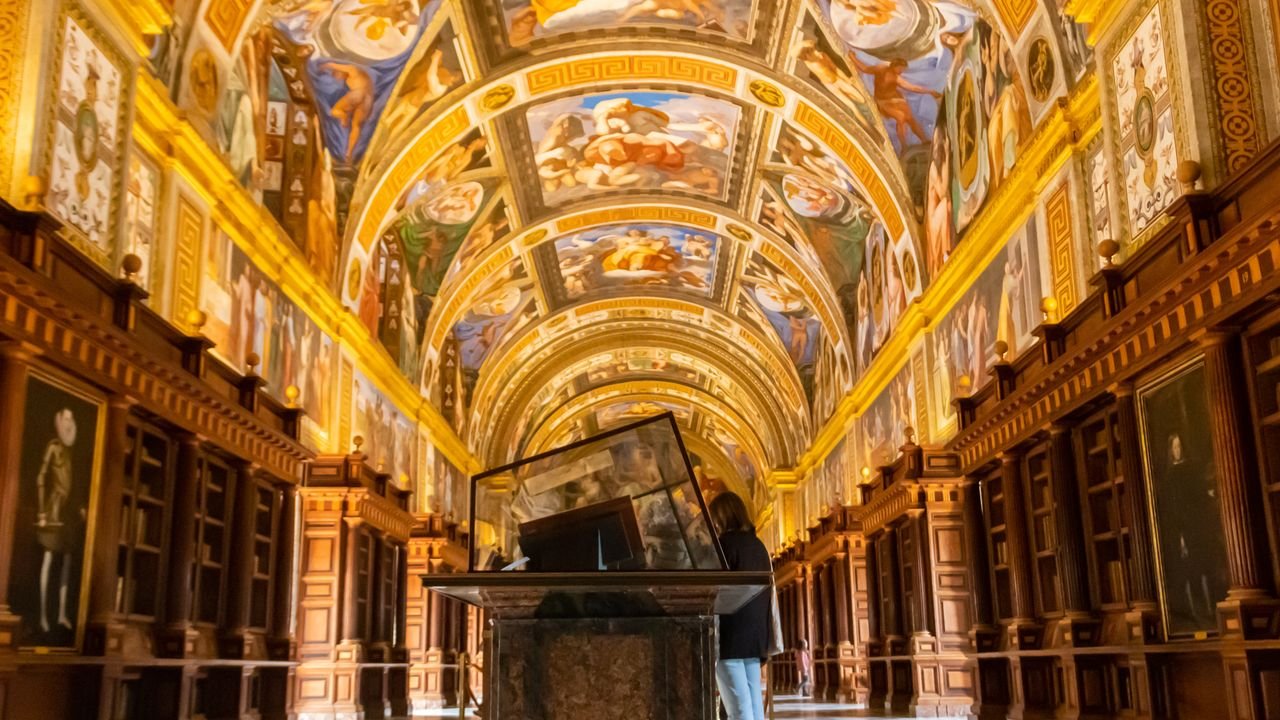
Part of the UNESCO-listed Royal Site of San Lorenzo de El Escorial, the monastery’s library was established in the late 16th century under King Philip II as a repository for humanist learning. Its long barrel-vaulted hall, completed by architect Juan de Herrera, reflects the sober classical style that defines the larger complex. The collection, now over 40,000 volumes, includes Greek and Arabic manuscripts, early cartographic works and rare scientific treatises gathered from across the Iberian world. Shelving is arranged in the “wall system,” with books stored upright along the perimeter to improve ventilation, an approach ahead of its time. Frescoes by Pellegrino Tibaldi depict the liberal arts and the four faculties of medieval knowledge, situating the library within the intellectual framework of its era. Access to the hall is controlled, and only a portion of manuscripts is shown in rotating cases.
7. Haeinsa Temple Janggyeong Panjeon, the Depositories for the Tripitaka Koreana Woodblocks
Gayasan National Park, South Korea

At Haeinsa, a 9th-century Buddhist temple set within South Korea’s Gayasan National Park, the Janggyeong Panjeon stands as a rare example of architecture built entirely in service of preservation. The UNESCO-inscribed complex houses the Tripitaka Koreana: over 80,000 13th-century woodblocks containing one of the most accurate editions of Buddhist scripture in existence. The buildings themselves, dating to the 15th century, function as an early climate-control system: elevated floors, open slatted windows and a careful north-south orientation regulate humidity and airflow. The result is a collection that has survived wars, fires, and centuries of monsoon weather with minimal deterioration. Visitors cannot enter the repositories, but walkways along the exterior allow close views of the austere wooden structures and their distinctive clay-and-charcoal foundations. The rest of the temple grounds remain active, anchoring the depository within a living monastic community.